The HBM Pre-Sell Phenomenon: How SK Hynix Sold Out 2026 Capacity Before Year-End
Memory chips have traditionally been a business of uncomfortable surprises. Demand accelerates, manufacturers expand, inventories accumulate, and prices eventually fall. The technology changes; the cycle often feels familiar.

Then artificial intelligence introduced a different kind of headline: next year’s production was already spoken for.
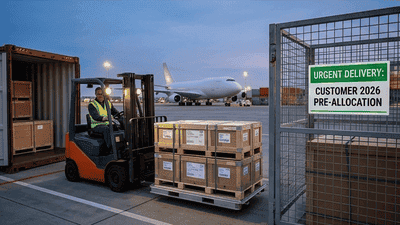
On October 29, 2025, SK hynix said it had secured customer demand for its entire planned 2026 production of DRAM, high-bandwidth memory, and NAND. It had also completed discussions with key customers over 2026 HBM supply. The announcement arrived more than two months before the year ended, turning a capacity-planning update into a powerful signal about the global semiconductor cycle.
Yet “sold out” needs careful interpretation. It does not mean every chip had been manufactured, delivered, or paid for. Nor does it establish that every agreement carried identical pricing or cancellation protection. It means customer commitments and supply arrangements had absorbed the production the company expected to offer.
That distinction makes the story more interesting, not less. The HBM pre-sell phenomenon reveals how AI is changing the timing of semiconductor demand, the allocation of manufacturing capacity, and the balance of power between suppliers and customers.
When Memory Becomes an Infrastructure Reservation
For a conventional electronics manufacturer, memory can sometimes look like a component purchased against a production schedule. For an AI accelerator designer, HBM increasingly looks like infrastructure that must be secured before the finished system can exist.
The reason is straightforward. Advanced processors need enormous amounts of data delivered quickly enough to keep their compute engines productive. HBM places stacked DRAM close to the processor through advanced packaging, providing a wide interface and high bandwidth.
Its value comes from that arrangement, not simply from storing more bytes.
A buyer cannot necessarily replace one HBM product with another at short notice. Compatibility involves the accelerator, memory interface, package design, thermal behavior, reliability requirements, and qualification process.
Consequently, securing supply becomes part of platform planning. Customers need confidence that the right memory will be available when processors, packaging, boards, and server systems converge.
Pre-selling is therefore more than an expression of enthusiasm. It is a way to coordinate a tightly interdependent supply chain.
Why SK Hynix Became a Natural Bottleneck

SK hynix entered this period with a strong position in advanced HBM and an important role supplying Nvidia’s AI accelerator ecosystem. That positioning mattered because customers were not shopping for undifferentiated memory capacity.
They wanted qualified products, dependable yields, and delivery schedules that matched expensive platform launches.
In HBM, manufacturing capability includes more than producing working DRAM dies. Those dies must be thinned, interconnected, stacked, tested, and prepared for integration into a complex package.
Each additional stage creates opportunities for defects, delays, or performance variation. A supplier that executes consistently can become difficult to replace even when another manufacturer announces a technically competitive product.
That is the foundation of the pre-sell advantage: confidence in usable output.
But leadership is not permanent. Samsung and Micron have powerful incentives to improve their offerings and win allocations. Customers also benefit from multiple qualified suppliers. SK hynix’s position explains the strength of its order visibility; it does not eliminate competition.
“Sold Out” Is a Demand Signal, Not a Revenue Receipt
The phrase invites an appealing shortcut: if production is sold out, next year’s revenue must already be guaranteed.
Reality is more conditional.
Commercial arrangements can contain volume commitments, pricing negotiations, product specifications, qualification milestones, and delivery schedules. Public statements do not necessarily reveal the complete contractual protections attached to them.
Moreover, production plans can change. Better yields may increase output. New equipment may arrive sooner or later. Customers may adjust their product mix, and an emerging generation of HBM may ramp differently from expectations.
A fully allocated plan therefore offers stronger visibility than an uncommitted production forecast, but it is not equivalent to completed sales.
The analytical question is whether reservations become qualified shipments at attractive margins. That conversion depends on execution at both ends: the supplier must manufacture successfully, and the customer must deploy the systems that consume the memory.
The Hidden Mechanism: HBM Competes for Factory Resources
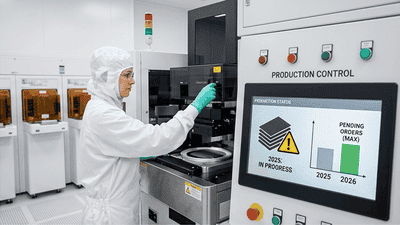
The macroeconomic importance of HBM extends beyond its own market.
HBM uses DRAM manufacturing resources, but its production requirements differ from those of conventional memory. Die design, processing, stacking, and yield all influence how much saleable output a given capacity base can produce.
Allocating more resources to HBM can constrain the growth of conventional DRAM supply. SK hynix explicitly highlighted this pressure when discussing its outlook: the shift toward HBM was limiting conventional memory output.
This creates a transmission mechanism from AI investment to the wider electronics economy.
A company buying memory for ordinary servers or consumer devices may face tighter supply even if its own demand is not booming. The constraint originates elsewhere, as manufacturers prioritize products with stronger demand and more attractive economics.
The process is not one-for-one, and factories are not infinitely interchangeable. Still, product allocation matters. The relevant question is no longer only how many wafers the industry starts, but what those wafers are being used to make.
One Semiconductor Industry, Several Different Cycles
This is where sweeping “semiconductor supercycle” language can become misleading.
AI memory may enjoy exceptionally strong demand while other chip categories remain tied to slower consumer spending, industrial investment, or automotive production.
Even within memory, HBM, conventional DRAM, and NAND have different supply-demand dynamics. NAND does not become scarce simply because an HBM stack uses more DRAM resources. Its market depends on separate manufacturing capacity and storage demand.
AI infrastructure can support several categories simultaneously, but the connections differ:
- HBM supports the bandwidth requirements of advanced accelerators.
- Server DRAM provides working memory for host systems and other compute workloads.
- NAND-based storage supports datasets, model files, checkpoints, and application data.
SK hynix’s broad 2026 demand coverage was therefore notable. But it should not be treated as proof that every semiconductor supplier faced the same conditions.
The industry was becoming more uneven: strong investment in selected infrastructure could coexist with weaker demand elsewhere.
A New Cycle—or a Familiar Cycle With Longer Contracts?
The strongest argument for a structural change is that HBM encourages earlier coordination and deeper supplier-customer integration.
Customers cannot wait until the last minute to buy qualified memory for a sophisticated accelerator. Suppliers cannot justify major manufacturing investments solely on optimistic conversations.
Longer planning horizons can reduce uncertainty on both sides.
That could make this cycle less dependent on short-term purchasing swings than earlier commodity-memory expansions. But the distinction should not be exaggerated.
Forward reservations can still exceed eventual consumption. Customers may secure extra supply because shortages appear dangerous. Competitors may invest simultaneously. Product transitions may create mismatches between available capacity and the memory generation buyers actually need.
The enduring variable is discipline: whether manufacturers expand against credible end demand rather than assuming every reservation represents permanent growth.
Contracts change how the cycle unfolds. They do not abolish it.
HBM4 Adds Opportunity and Execution Risk
The transition toward HBM4 added another dimension to the 2026 planning story. SK hynix discussed expanding HBM4 sales alongside its existing products, making generation mix an important part of the capacity outlook.
A new generation can deliver higher performance and support more advanced accelerator platforms. It can also require new qualification work, manufacturing learning, and coordination with processor and packaging partners.
That means HBM capacity is not a single homogeneous number.
A factory’s ability to produce one generation does not guarantee that every customer can immediately use its output. Nor should the latest generation be assumed to replace all earlier products overnight.
Existing platforms may continue consuming HBM3E while newer systems introduce HBM4. Suppliers must manage the overlap without producing the wrong mix.
For investors and industry planners, the quality of growth matters as much as the quantity: yields, customer acceptance, and product economics determine whether a technology transition strengthens earnings or temporarily complicates them.
Why More Spending Does Not Immediately Solve the Shortage
Strong demand naturally encourages capital expenditure. But announcing investment is much faster than creating qualified production.
New facilities require construction, utilities, cleanrooms, equipment installation, process development, and production ramp-up. Existing facilities may expand more quickly, yet they still depend on equipment availability and operating execution.
HBM also requires attention to back-end capacity. Adding wafer processing alone may not resolve constraints in stacking, testing, or integration.
This lag explains why customers reserve output so far ahead. Supply cannot respond instantly to a sudden increase in accelerator demand.
It also creates the classic cyclical danger. By the time new capacity becomes productive, the demand environment may have changed.
The same investment that relieves a shortage can eventually create excess supply if too many projects arrive together. The crucial distinction is between spending announced today and usable, economically competitive output delivered later.
The Customer’s Calculation Is Bigger Than Memory Pricing
For an AI infrastructure buyer, expensive memory can still be preferable to unavailable memory.
A delayed accelerator shipment can postpone revenue, idle other components, or disrupt a data-center deployment. The economic cost may exceed the savings from waiting for a lower memory price.
This helps explain why supply assurance becomes valuable during a rapid infrastructure buildout.
However, willingness to pay is not unlimited. Operators ultimately need useful computing output at sustainable cost. If infrastructure spending rises faster than application revenue or internal productivity gains, purchasing behavior can change.
Memory reservations sit inside that larger financial equation. Strong commitments may reflect strategic urgency, but their durability depends partly on the economics of the systems they support.
The macro cycle therefore runs from capital spending to deployment to utilization—not merely from chip orders to factory output.
How to Read the Next Phase
A sold-out announcement is an important opening signal. Assessing the cycle requires following what happens afterward.
Several indicators deserve particular attention:
- Whether reserved volumes convert into shipments without major schedule changes.
- Whether new-generation yields improve as production expands.
- Whether conventional DRAM pricing reflects persistent supply constraints or temporary inventory rebuilding.
- Whether customer deployment and utilization keep pace with hardware purchases.
- Whether suppliers add capacity faster than underlying consumption grows.
- Whether competitors gain qualifications that broaden available supply.
No single indicator settles the debate. Together, they help distinguish a sustained infrastructure expansion from a shortage amplified by precautionary ordering.
That distinction matters especially when market valuations already assume several years of strong earnings.
The Real Meaning of the HBM Pre-Sell Phenomenon
SK hynix’s ability to allocate its planned 2026 production before the end of 2025 illustrated a meaningful shift: advanced memory had become a strategic prerequisite for AI infrastructure, rather than a component buyers could safely leave until later.
The consequences reached beyond HBM. Capacity allocation affected conventional DRAM, investment decisions spread across manufacturing and packaging, and the industry’s strongest growth became concentrated in particular parts of the supply chain.
Yet the most useful conclusion is not that memory has escaped cyclicality. It is that the cycle now operates through a more complex combination of qualification, reservations, product mix, and infrastructure economics.
The empty space in an order book has become less visible. The risks have not disappeared; they have moved downstream into execution and eventual consumption.